
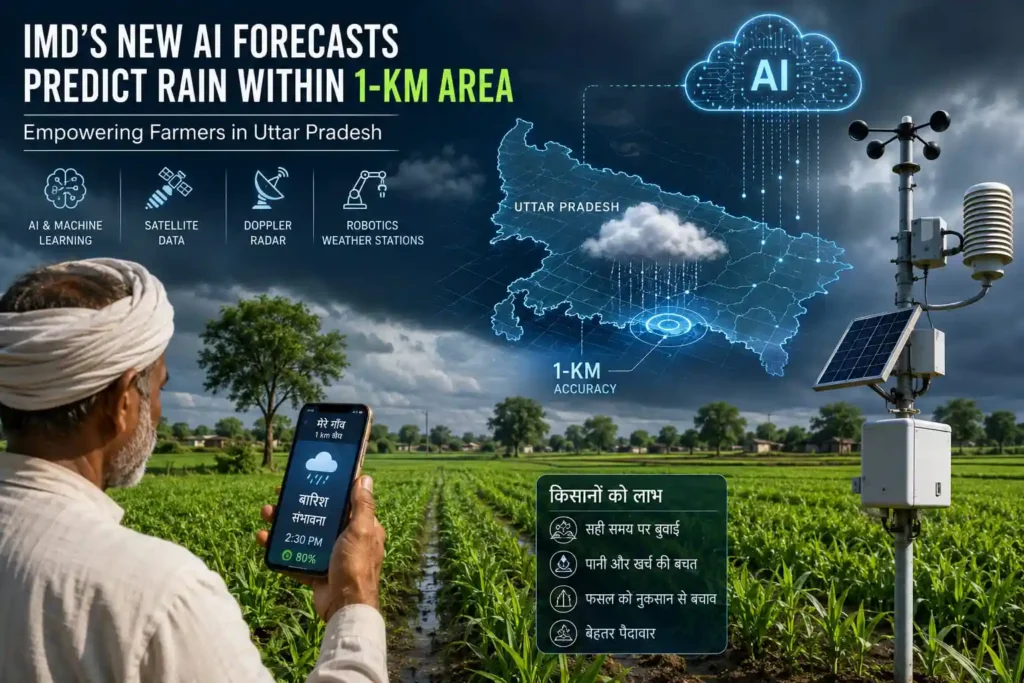
India’s weather forecasting is entering a new era powered by Artificial Intelligence and robotics-driven data systems. The India Meteorological Department (IMD), in collaboration with the National Centre for Medium Range Weather Forecasting (NCMRWF), has introduced an advanced AI-powered forecasting model capable of predicting rainfall within a 1-kilometre radius — a technological leap that could redefine farming across Uttar Pradesh.
The breakthrough marks one of the most ambitious applications of AI and robotics-backed weather intelligence in Indian agriculture, where unpredictable monsoons continue to impact millions of farmers every year.
AI Robotics Technology to Predict Rainfall at Hyperlocal Level
Unlike traditional district-level weather forecasts, the new IMD system uses Artificial Intelligence, machine learning algorithms, satellite inputs, Doppler radar observations, and robotics-enabled automated weather stations to generate hyperlocal weather predictions.
The forecasting model can identify rainfall patterns, cloud movement, humidity changes, and wind behaviour with remarkable precision, allowing farmers to know exactly when rain is likely in their village or even within a specific farmland cluster.
Officials said the system currently focuses on Uttar Pradesh as a pilot project, one of India’s largest agricultural states with massive dependence on monsoon rainfall.
The AI weather model analyses enormous volumes of real-time atmospheric data every few minutes. Advanced robotics-based sensors installed across weather monitoring stations continuously transmit updates to supercomputers operated by NCMRWF.
These AI systems then process the data to produce highly localised forecasts that can significantly improve agricultural decision-making.
How the AI Forecasting System Will Help Farmers
For farmers, even a few hours of advance rainfall information can make a massive difference.
The new AI-driven forecasting product can help farmers decide:
- When to sow seeds
- When to irrigate crops
- When to apply fertilisers
- When to spray pesticides
- When to harvest produce
- How to protect crops from extreme weather
Agricultural experts believe hyperlocal AI weather forecasting could reduce crop losses caused by sudden rain, storms, or dry spells.
For example, if rainfall is expected in a specific 1-km agricultural zone, farmers can avoid unnecessary irrigation, saving both water and electricity costs.
Similarly, pesticide spraying before unexpected rainfall often results in huge financial losses. Precise AI rainfall alerts can help farmers avoid such mistakes.
Robotics and AI Becoming the Backbone of Modern Agriculture
The IMD initiative also highlights how robotics and Artificial Intelligence are becoming deeply integrated into India’s agriculture ecosystem.
Modern weather stations today rely on automated robotic instruments capable of measuring:
- Soil moisture
- Atmospheric pressure
- Wind speed
- Temperature
- Rainfall intensity
- Humidity levels
These robotic monitoring systems operate continuously without manual intervention and feed real-time information into AI-powered forecasting engines.
Experts say this combination of robotics, satellite technology, and AI modelling is creating a “smart weather ecosystem” for Indian agriculture.
Why Uttar Pradesh Was Chosen
Uttar Pradesh was selected for the first rollout because of its large farming population and diverse climatic conditions.
The state frequently experiences:
- Floods
- Heatwaves
- Unseasonal rainfall
- Drought-like conditions
- Fog-related disruptions
With millions dependent on agriculture, accurate AI weather forecasting could improve crop productivity and reduce financial uncertainty for farmers.
Officials indicated that if the pilot proves successful, the forecasting system could later expand to other states across India.
AI Forecasting Could Strengthen India’s Climate Resilience
Climate change has made weather increasingly unpredictable across India.
Erratic monsoons, extreme rainfall events, rising temperatures, and changing seasonal cycles are putting pressure on food production systems.
Scientists believe AI-powered weather forecasting can become a critical tool in building climate resilience.
By predicting weather conditions with greater precision, governments and disaster management agencies can also prepare faster responses to floods, lightning strikes, and severe storms.
The new IMD forecasting technology could also support crop insurance systems by providing more accurate weather records and event verification.
India’s Push Toward AI-Driven Governance
The launch reflects India’s broader push toward integrating Artificial Intelligence into public infrastructure and governance systems.
AI technologies are already being used in:
- Healthcare diagnostics
- Smart city projects
- Traffic management
- Financial fraud detection
- Crop monitoring
- Disaster prediction systems
Weather forecasting is now emerging as another major sector where AI and robotics can directly impact everyday life.
Government agencies are increasingly investing in high-performance computing, automation, and predictive analytics to improve public services.
Challenges Ahead for AI Weather Systems
While the technology promises major benefits, experts caution that challenges remain.
Hyperlocal forecasting requires:
- Dense sensor networks
- Continuous real-time data collection
- High computational power
- Accurate calibration models
- Reliable rural communication systems
Many rural areas still face internet connectivity limitations that could affect real-time dissemination of weather alerts.
Additionally, educating farmers on how to interpret and use AI-generated forecasts will be essential for widespread adoption.
A New Era of Smart Farming
Despite challenges, the launch of IMD’s AI-based 1-km rainfall forecasting platform represents a major milestone for India’s agricultural technology landscape.
As robotics, AI, satellite imaging, and predictive analytics become more sophisticated, experts believe India could move closer to a future of precision agriculture where farming decisions are guided by real-time intelligence.
For millions of farmers in Uttar Pradesh, knowing exactly when rain will fall could soon become less about uncertainty — and more about data-driven planning powered by Artificial Intelligence.